How to check case status by CNR number on eCourts
13 October 2026 · April AI team
If you have a case in an Indian district court, the quickest way to follow it is its CNR number. Here is what the number means and how to use it.
What is a CNR number?
CNR stands for Case Number Record. It is a unique 16-character number given to every case filed in courts on the eCourts system. Unlike the case number, which can repeat across courts and years, the CNR is unique across the country and stays with the case for its whole life.
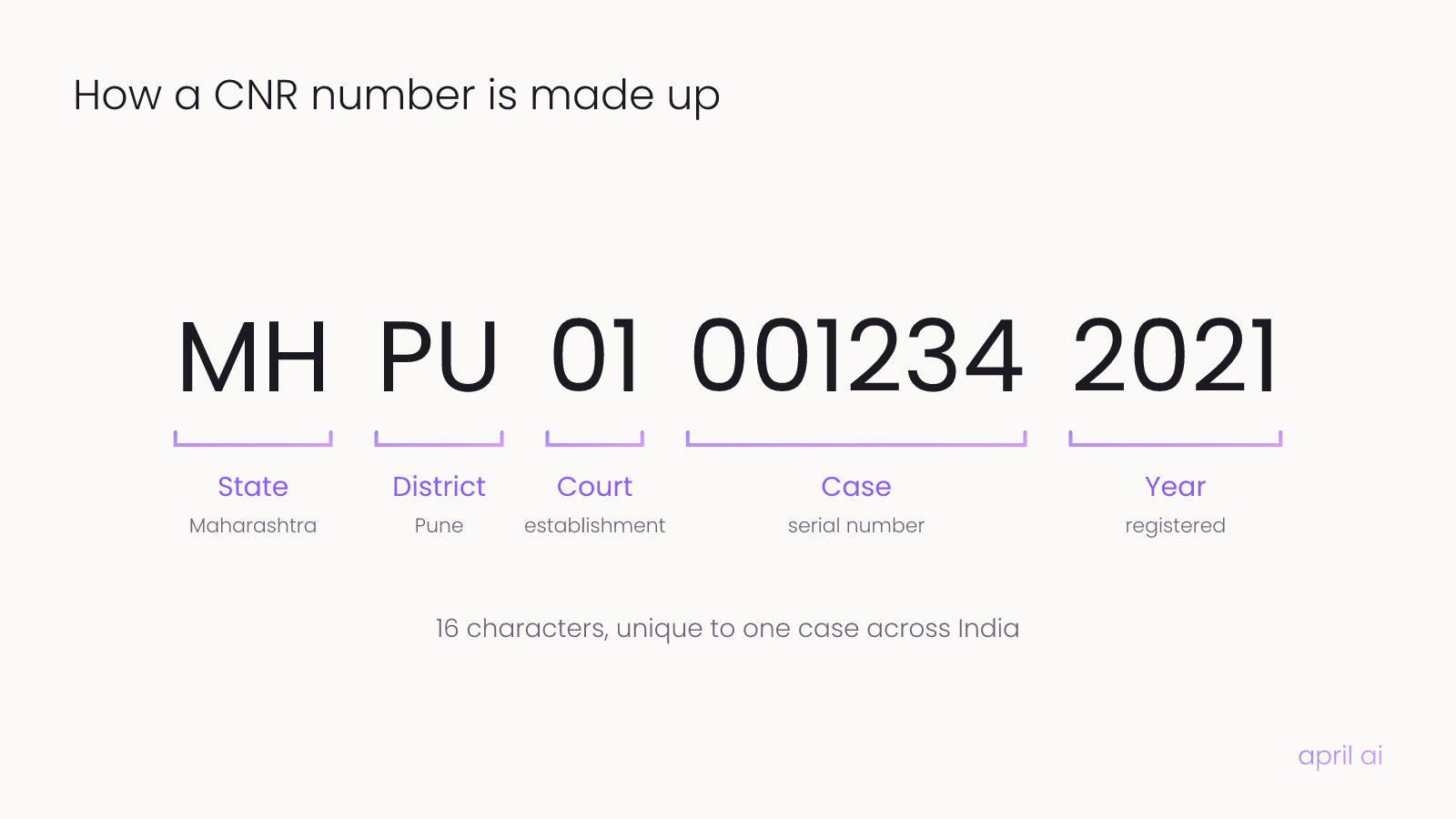
How to read it
A CNR looks like this: MHPU010012342021. It has four parts:
- MH: the state code (here, Maharashtra).
- PU: the district code (here, Pune).
- 01: the court establishment code.
- 001234 2021: the case's serial number and the year it was registered.
Where to find it
- On the case filing receipt or the first order sheet.
- On the cause list or any order downloaded from eCourts.
- From your advocate, who can find it on eCourts from the case number.
How to check case status
- Open the eCourts services website (services.ecourts.gov.in) or the official eCourts Services app.
- Choose CNR Number search.
- Enter the 16 characters without spaces or dashes, and the captcha.
- You'll see the case details: parties, advocates, the stage, the last and next hearing dates, and the history of hearings.
- Orders and judgements, where uploaded, can be opened as PDFs.
High Court cases have their own CNR and are searched on the High Court services pages of eCourts.
Common problems
- "Record not found": check for typing mistakes; letters must be capitals. Some older cases were registered before the CNR system and may not show.
- Next date missing: the court may not have updated it yet. Check again the next day.
- Order not uploaded: courts upload orders at different speeds; ask the court staff or your advocate.
Track it without checking every day
Checking eCourts by hand for every case is slow, and dates are easy to miss. In April's lawyer portal you enter a CNR once; April fetches the case record, hearing history and orders, checks again after each hearing and tells you what changed. Clients linked to their advocate can see their case's next date in their own April account.
Ask April in your own words. Your first questions each month are free.
Ask April