What is contract lifecycle management (CLM)? A plain guide for Indian companies
1 October 2026 · April AI team
Every company runs on contracts: with customers, vendors, employees, landlords and partners. Yet in most Indian companies those contracts live in email threads, WhatsApp chats, Word files on someone's laptop and a shared drive nobody trusts. Contract lifecycle management, or CLM, is the practice (and the software) that fixes this.
What CLM means
A contract has a life. It is drafted, negotiated, approved, signed, stored, watched and finally renewed or ended. CLM means managing all of those stages in one place, so that anyone with the right access can answer simple questions quickly:
- Which version is the final one?
- Who approved it, and when?
- Who signed it, and where is the signed copy?
- When does it renew, and how much notice do we need to give?
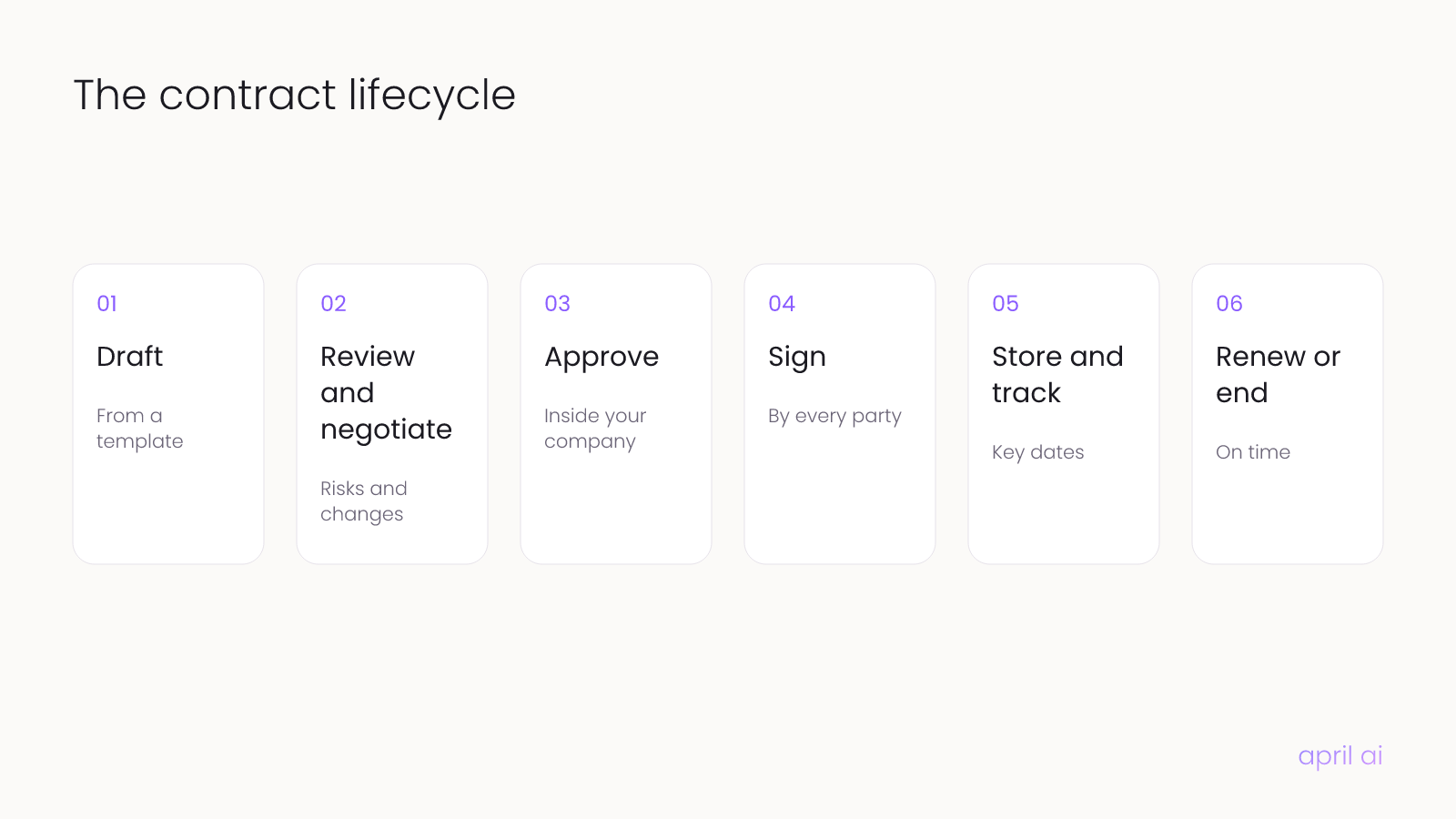
The six stages
- Draft. Someone writes the first version, usually from a template or an old contract.
- Review and negotiate. Your side checks the risks; the other side asks for changes. Versions go back and forth.
- Approve. Someone inside the company, often finance or legal, signs off before it goes out.
- Sign. Every party signs, today usually online.
- Store and track. The signed copy is kept safely, with its key dates: renewal, notice, payment milestones.
- Renew or end. The contract is renewed, renegotiated or allowed to end on time, not by accident.
What goes wrong without it
Most contract problems are not legal mistakes. They are process mistakes:
- An old version is signed because two people edited two copies.
- A contract goes out without finance seeing the payment terms.
- A one-sided indemnity clause slips through because nobody had time to read 30 pages.
- A vendor contract renews automatically for another year because the notice date was missed.
- When a dispute comes, nobody can find the signed copy.
Each of these costs money, and all of them are avoidable.
What CLM software does
Good CLM software gives you one workflow for every contract:
- Drafting from templates, with your standard clauses.
- Review that marks risky or missing clauses before you sign.
- Approvals that send the contract to the right people in the right order.
- E-signature, so signing takes minutes, not courier days.
- A single record of versions, comments, approvals and signatures.
- Reminders for renewal and notice dates.
Newer tools add AI. April, for example, drafts a full contract from a few answers, reads uploaded agreements clause by clause, and suggests the exact wording to ask for.
Do small companies need CLM?
Yes, but they need less of it. A ten-person startup does not need a complex approval matrix on day one. It does need one place for its contracts, signed copies it can find, and a reminder before a renewal. Start simple and add approval rules and roles as the team grows.
How to start this month
- Collect your signed contracts in one place, even if it is just a folder.
- List each contract's other party, value, end date and notice period.
- Pick standard templates for the contracts you sign most often.
- Decide who must approve a contract before it is sent.
- Move new contracts into a CLM tool and bring old ones in as you touch them.
April's contract management software covers the whole lifecycle for companies in India and the UAE, and you can start free.
Ask April in your own words. Your first questions each month are free.
Ask April